Golf Computer Vision & Markerless Club Tracking on iPhone
- The Challenge: Markerless Golf Club Estimation
- Building the Golf Club Tracking Software
- Dataset Development and Model Training
- From Golf Club Tracking to Automated Golf Swing Analysis
- Validation for Markerless Golf Swing Analysis
- Optimizing Golf Computer Vision for iPhone
- Above-Real-Time Performance on iPhone
- Golf Swing Camera Software Built on an Ordinary iPhone
- Foundation for AI Golf Swing Analysis and Golf Swing Coach AI
- Current Stage and Next Steps
- ParadigmaST's Role in Golf Computer Vision Development
ParadigmaST worked with a sports tech company developing technology for movement analysis and performance analytics.
The goal was to determine whether an ordinary iPhone could be used for accurate golf club tracking and objective swing analysis without professional motion-capture equipment or physical markers.
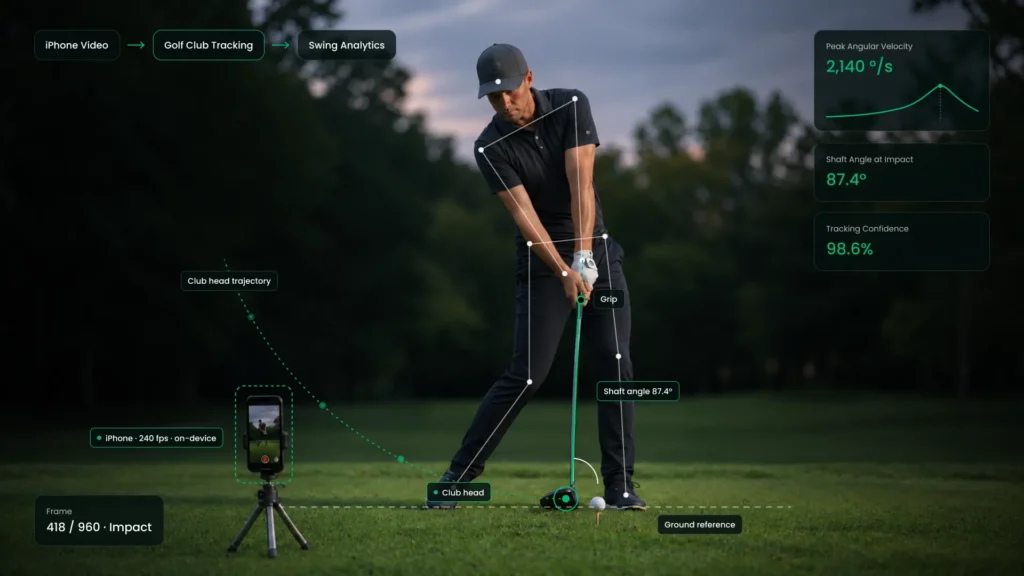
The input scenario was intentionally simple: slow-motion video recorded on an iPhone from a face-on position, with the athlete, ball, and club visible in the frame.
The challenge was turning that video into a stable motion signal suitable for AI golf swing analysis and physics-based performance metrics.
The Challenge: Markerless Golf Club Estimation
A golf club is a difficult object for computer vision. The shaft is extremely thin relative to the frame, moves at high speed, changes orientation rapidly, and can become heavily blurred or partially hidden behind the athlete.
For useful analytics, detecting the club in individual frames is not enough. The estimates of its position and orientation need to remain stable across the complete swing sequence.
Even relatively small tracking errors carry through into every downstream calculation, such as shaft angle, angular velocity, impact timing, clubhead trajectory, and swing-phase duration.
The core technical question was therefore whether markerless golf club tracking from ordinary iPhone video could produce a sufficiently stable signal for objective sports analytics.
Building the Golf Club Tracking Software
ParadigmaST developed and trained a computer vision model specifically for golf club motion.
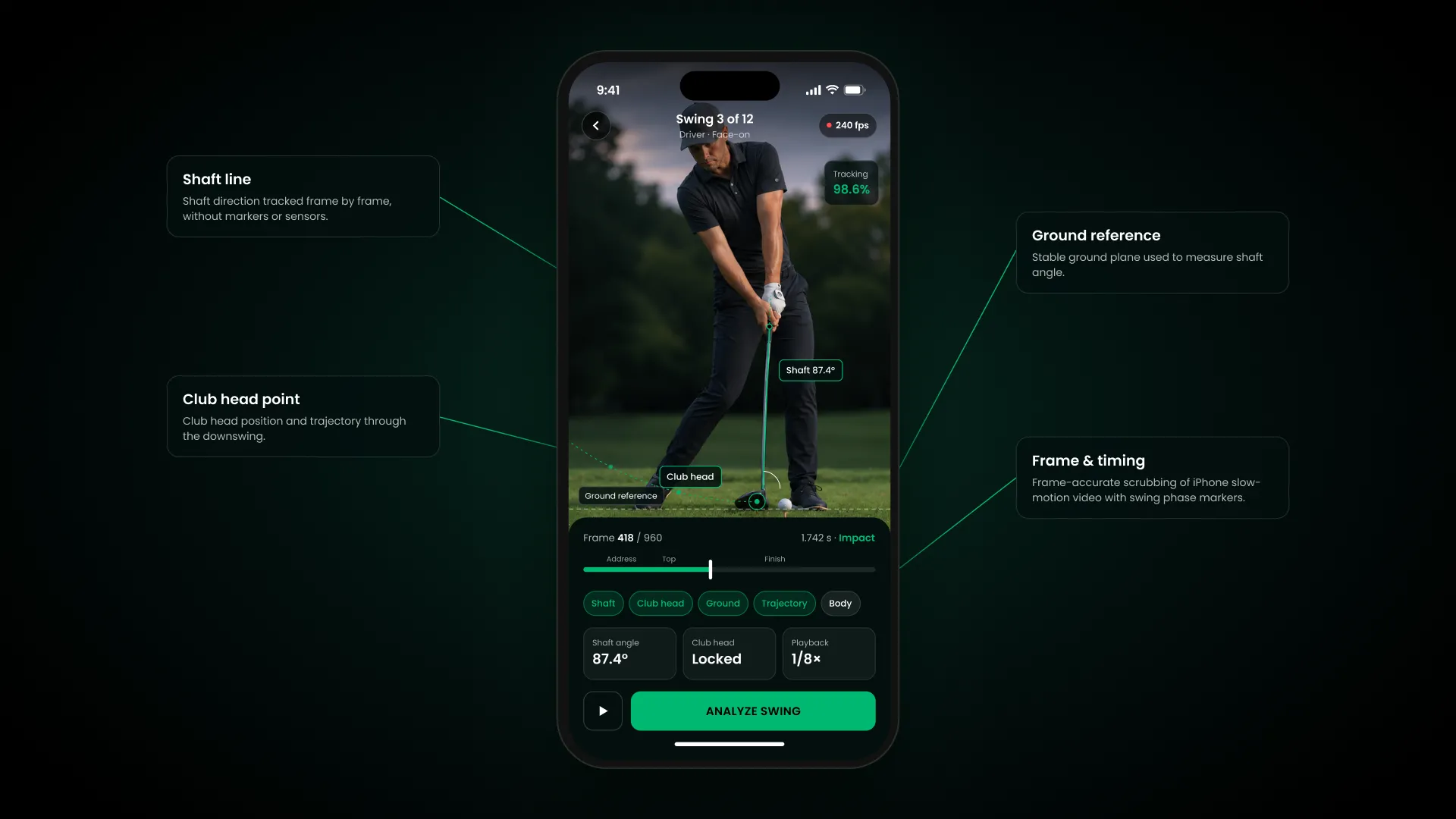
Frame by frame, the tracking engine reconstructs the club’s main spatial characteristics, including:
- shaft direction and orientation;
- key club points;
- clubhead position;
- changes in angle and position over time;
- position relative to a ground reference.
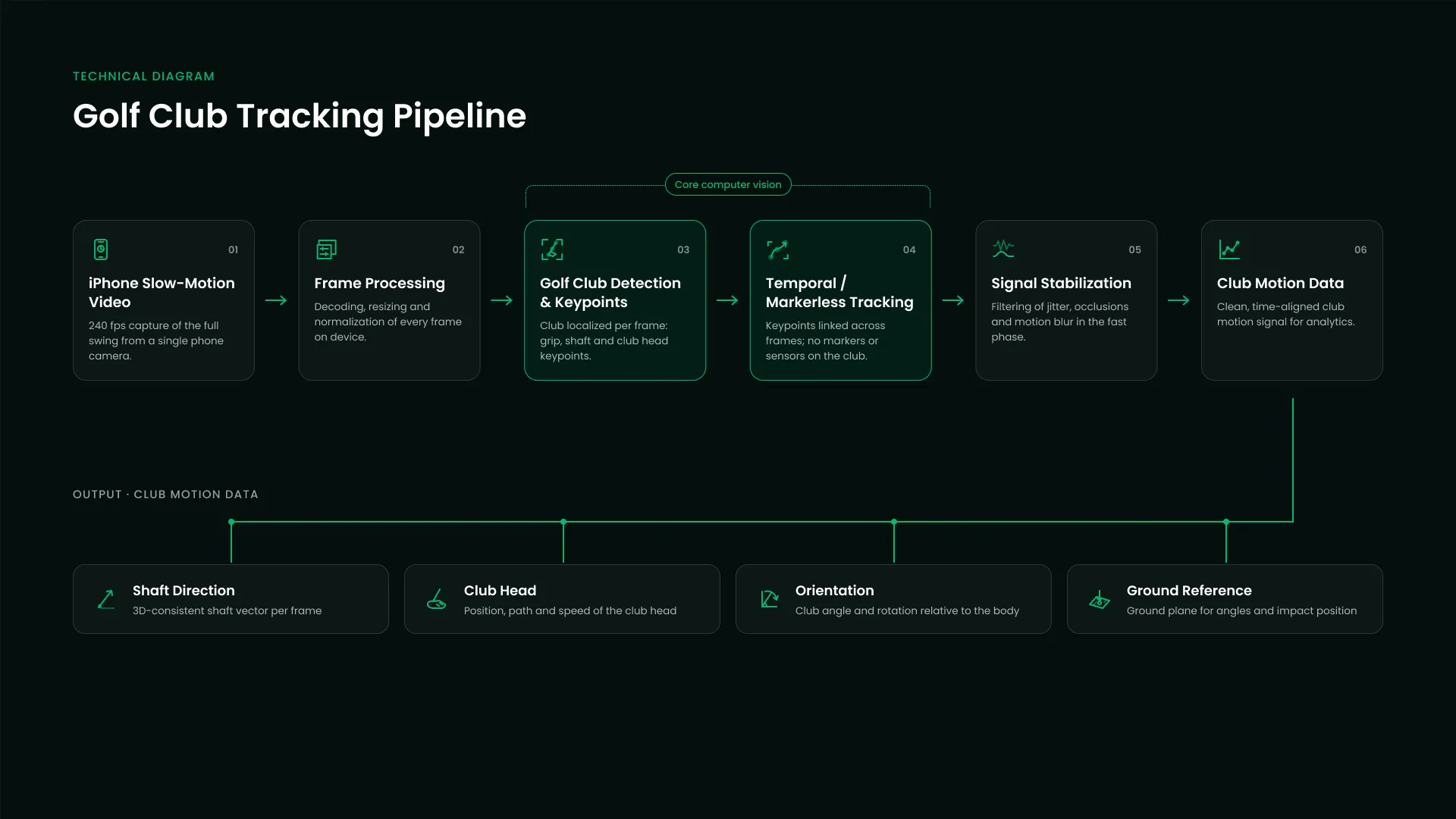
Rather than treating each image independently, the tracking engine uses temporal information from neighboring video frames to stabilize estimates of the club position and orientation. This helps reduce frame-to-frame fluctuations and maintain a consistent motion sequence when the shaft becomes briefly blurred or partially occluded.
This temporal consistency is what turns basic visual detection into usable golf club tracking software.
Dataset Development and Model Training
A dedicated ML pipeline was created around golf swing footage.
The work included video selection, frame-by-frame annotation, model training, error analysis, and iterative retraining. A focused dataset of golf swing videos was manually annotated for model development and validation. Separate videos, excluded from the training set, were reserved for independent evaluation.
Particular attention was given to the difficult scenarios that most affect this type of model: fast rotation, motion blur, partial occlusion, difficult club positions, and frames where only a very small part of the club remains visible.
The main evaluation criterion was not simply whether the model could detect the club. The tracking output had to remain stable enough over time to support subsequent physics-based calculations.
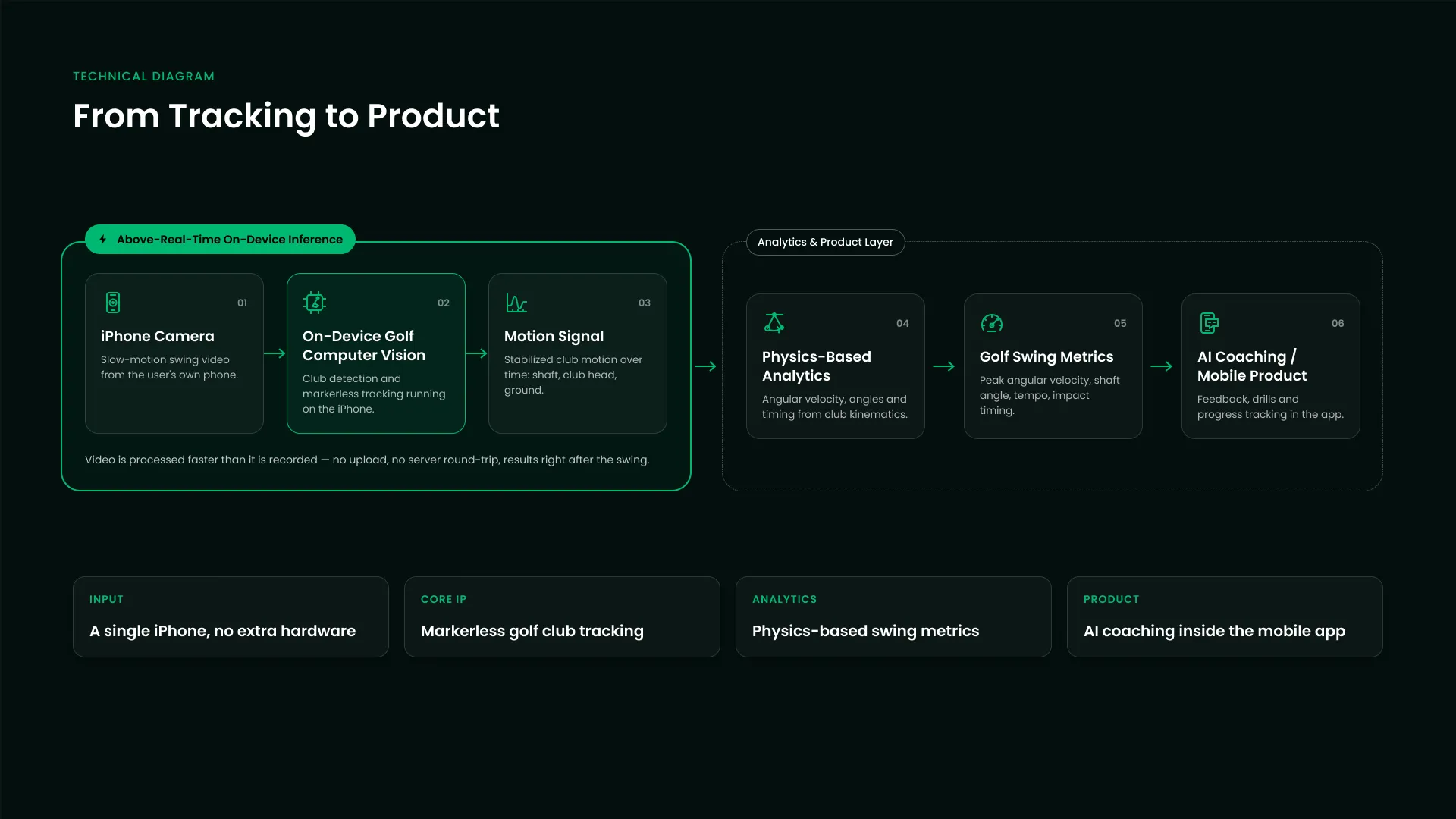
From Golf Club Tracking to Automated Golf Swing Analysis
Once reliable frame-by-frame tracking is available, automated golf swing analysis becomes a separate computational layer.
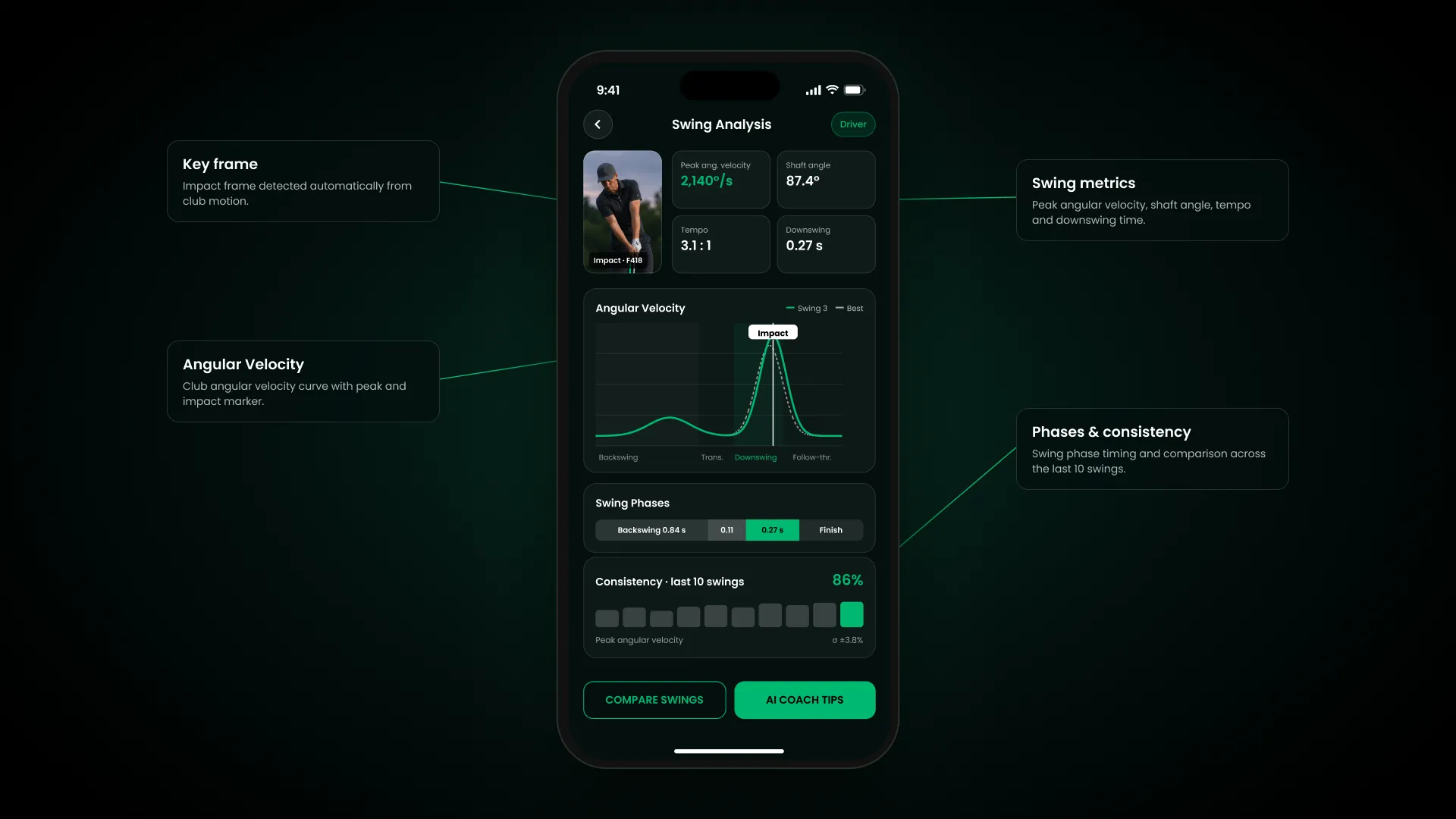
The reconstructed motion provides the data needed to calculate metrics such as:
- shaft angle and angle change over time;
- angular and peak angular velocity;
- acceleration and deceleration patterns;
- impact-related timing;
- swing-phase duration;
- clubhead trajectory;
- consistency between repeated swings.
This architecture makes the tracking engine reusable. New performance metrics or coaching features can be developed on top of the same motion data without solving the computer vision problem again.
Validation for Markerless Golf Swing Analysis
The tracking output was validated to check whether the reconstructed club movement was accurate and stable enough for physics-based analytics.
For validation, ParadigmaST reserved an independent set of golf swing videos that had not been used during training. The relevant club positions and orientations were manually annotated, then compared with the predictions generated by the tracking engine. This enabled an objective assessment of geometric tracking accuracy and consistency over the swing sequence.
The results confirmed the central hypothesis of the project:
| Markerless golf swing analysis can be built using ordinary iPhone video as the source for reconstructing golf club motion and calculating objective performance data. |
Optimizing Golf Computer Vision for iPhone
The initial R&D and validation ran without mobile-device constraints, so those limits wouldn’t shape the model too early.
Once the tracking quality had been confirmed, ParadigmaST adapted the model and inference pipeline for the iPhone, taking into account hardware acceleration, memory usage, latency, and mobile computational limits.
The model had to do more than run on the device. It had to preserve the tracking quality required for downstream analytics while operating efficiently on mobile hardware.
Above-Real-Time Performance on iPhone
After mobile optimization, the tracking engine could process recorded golf swing video faster than normal playback directly on the iPhone while maintaining the required tracking quality. The current workflow uses recorded slow-motion video rather than a live camera feed, so this should not be confused with a fully live real-time golf swing analysis product.
However, above-real-time inference provides the performance foundation for responsive mobile analytics and future real-time or near-real-time workflows.
Reaching this speed on the device moved the project beyond a server-side R&D prototype and created a working on-device technology core.
Golf Swing Camera Software Built on an Ordinary iPhone
The iPhone acts as the capture device, while the computer vision engine turns the video into structured motion data. This means the camera is no longer limited to recording and replaying the swing.
The tracking engine enables capabilities that a product could build on, grouped into four areas:
- video overlays: shaft orientation, clubhead trajectory, and ground reference;
- motion metrics: shaft angle, angular velocity curves, and peak values;
- swing events: phase markers and impact timing;
- progress analytics: swing comparisons and consistency.
In this way, an ordinary iPhone can become the basis of golf swing camera software capable of extracting objective information from every recorded swing.
Foundation for AI Golf Swing Analysis and Golf Swing Coach AI
The tracking engine also provides the technical foundation for a broader AI golf swing analysis product.
Because the core visual problem has already been solved for this capture scenario, future development can focus on interpreting the movement and converting it into useful feedback.
A future Golf Swing Coach AI layer could combine club-motion data with swing phases, historical performance, consistency analysis, coaching logic, and other athlete data to generate increasingly personalized feedback.
The same tracking engine can support different product configurations, from simple consumer swing analytics to more advanced tools for coaches and performance professionals.
Current Stage and Next Steps
The project combined dedicated Computer Vision and Machine Learning engineering with part-time senior CV/ML technical leadership and full-stack support for mobile and backend integration. The work spanned data preparation, model development, independent validation, and on-device optimization. The team and workstream involvement included:
- 1 Computer Vision Engineer: 2.5 months of involvement;
- 1 Machine Learning Engineer: 2.5 months of involvement;
- 1 Staff CV/ML Engineer (Technical Lead): approximately 120 hours, part-time;
- 1 Full-Stack Engineer (Mobile and Backend Integration): 1.5 months of involvement;
- Data annotation: one annotator for an estimated 4 weeks, with CV-engineer quality review.
These are workstream efforts that overlapped, so they reflect individual involvement rather than the overall project duration.
ParadigmaST developed the specialized model, trained it on golf swing footage, validated the reconstructed motion, confirmed that the data can support physics-based calculations, and transferred the technology to the iPhone.
The optimized mobile implementation now performs above real-time.
Future development can therefore focus primarily on the product and analytics layers, including:
- deeper golf-performance metrics;
- automatic swing-phase and impact-zone detection;
- swing comparison and historical progress tracking;
- coaching insights and automated recommendations;
- mobile UI and session management;
- cloud synchronization and coach-facing tools.
The underlying approach is also being extended to baseball bat tracking, another high-speed sports-equipment tracking problem; this work is currently ongoing.
ParadigmaST’s Role in Golf Computer Vision Development
ParadigmaST is responsible for the core technology behind the project: computer vision and machine learning R&D, dataset development, model training, temporal tracking, physics-based motion analytics, mobile optimization, on-device deployment, and the software engineering required to integrate the solution.
The result is a reusable technology layer combining golf computer vision, markerless golf club tracking, Edge AI, mobile optimization, and physics-based sports analytics.
The same building blocks are reusable in other sports applications: tracking thin, fast-moving objects, extracting stable motion signals from ordinary smartphone video, and running ML models on-device without uploading raw video to a server. They apply to:
- baseball bat tracking, an extension already in progress;
- other high-speed sports-equipment tracking problems and sports tech products.